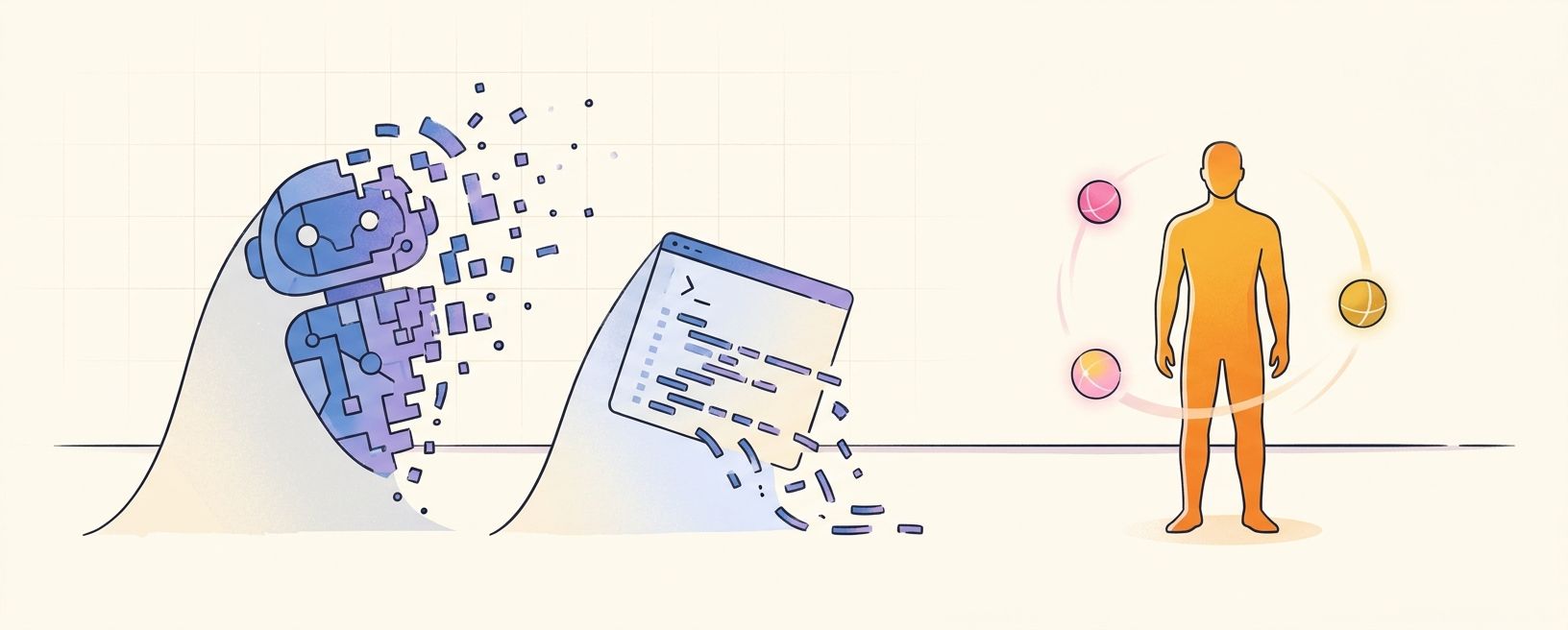

The AI SDR wave is already collapsing.
The promise was intoxicating: replace your SDR team with soft
ware, send thousands of personalised emails a day, book meetings while you sleep, and scale pipeline without hiring another human.
For a while, the category looked inevitable.
Every founder I knew was considering building one.
Every investor I read had seen a deck.
Every sales leader was asking the same question.
If AI can write, research, enrich, sequence, and follow up — why would you hire another SDR?
The answer is simple.
Because B2B selling is not an information-transfer problem. It is a trust-transfer problem.
And trust does not scale the way outbound software wants it to.
That is why I am not building another AI SDR.
I am building the opposite.
And before this essay is even finished, the next wave is already here.
Founders are wiring Claude Code and OpenClaw into their sales motion. Reps are being told to build their own personal sales hub in a terminal. The pitch sounds different. The bet is the same.
Replace the human work in sales with an agent.
I am not building that either.
Both waves will collapse for the same reason. I will get to that.
What AI SDRs got right
To be fair, AI SDRs were responding to a real problem.
Sales teams are drowning in work that is not selling.
Reps have to:
- Research accounts.
- Clean CRM fields.
- Write follow-ups.
- Update deal notes.
- Build call prep docs.
- Chase stale opportunities.
- Rewrite emails.
- Log activity.
- Search LinkedIn.
- Summarise meetings.
- Copy context from one tool into another.
None of that is the reason they were hired.
The best sellers are paid for judgment, timing, empathy, pattern recognition, and the ability to create trust with a buyer who has limited attention and high risk.
But most sellers spend the majority of their week doing everything around the conversation instead of the conversation itself.
So the AI SDR thesis had one thing right: sales teams need leverage.
Where it went wrong was deciding that the thing to automate was the human moment.
The category mistake
AI SDRs tried to automate the one part of sales that should not be automated: the moment a buyer decides whether they believe you.
That moment is fragile.
A buyer gets a message. They scan it in three seconds. Before they process the offer, they ask a simpler question:
“Was this actually written for me?”
If the answer is no, the message dies.
If the answer is “probably generated by a bot,” something worse happens. The buyer does not just ignore the message. They downgrade the sender.
That is the hidden cost of autonomous outbound. It does not merely fail to create trust. It burns trust before a human ever enters the room.
The AI SDR category assumed the buyer wanted more relevant information.
But the buyer wanted a reason to believe the person reaching out had done the work.
Those are not the same thing.
Why the AI SDR model breaks
The failure is not one bug. It is five compounding failures.
1. Buyers pattern-match the bot
AI-generated outbound has a texture.
The compliment is too broad. The personalisation is too shallow. The transition is too smooth. The ask comes too fast. The message sounds plausible but not earned.
Buyers now see that pattern everywhere.
Once buyers learn the pattern, the channel changes. Even good messages get treated with suspicion. Every sender pays the spam tax created by the worst senders.
That is the first problem with AI SDRs: they train buyers to distrust the channel they depend on.
2. Volume destroys the thing it tries to scale
Outbound worked when a thoughtful message was scarce.
AI SDRs made “personalised” messages cheap.
When everyone can send 10,000 messages, no one receives them as signal. The message becomes noise by default.
The more the category succeeds at generating volume, the less valuable each generated message becomes.
That is a negative-sum game.
3. The sender loses credibility
A bad human-written cold email is forgettable.
A bad AI-written cold email is brand-damaging.
The buyer does not think, “This automation tool made a mistake.” They think, “This company did not care enough to write to me properly.”
That matters.
In B2B sales, the first touch is not just a pipeline activity. It is a preview of how the company thinks, how carefully it listens, and how much judgment it applies.
If the first touch feels fake, the buyer assumes the rest of the motion will feel fake too.
4. Reps do not adopt tools positioned to replace them
This part is obvious and still under-discussed.
If you tell a sales team, “This tool is here to replace SDR work,” do not be surprised when the team resists it.
The adoption problem was baked into the positioning.
Sellers adopt tools that make them sharper, faster, and more successful. They resist tools that turn their craft into a commodity.
The AI SDR category sold automation to leadership and anxiety to the people expected to use it.
That is not a product-led growth motion. That is an organisational immune response.
5. The wrong metric wins
AI SDRs optimise for activity: emails sent, contacts enriched, sequences launched, meetings booked.
But the real constraint in modern B2B sales is not activity.
It is relevance.
A small team does not win by sending more messages than a large team. It wins by noticing better signals, moving faster on the right accounts, and showing up with sharper context than competitors.
The AI SDR model mistakes motion for progress.
Sales teams do not need more motion. They need better judgment at the exact moments that matter.
The Claude Code wave is making the same mistake
A year ago, every founder asked: “Why don’t we replace SDRs with AI?”
This year, the question has shifted.
It is now: “Why don’t we just put every rep on Claude Code or OpenCode and let them build their own sales hub?”
Same energy. Different surface.
The pitch sounds reasonable. Reps are smart. Coding agents are cheap through Claude/Codex subscription. CRMs are bloated. Why not let every seller spin up their own workflow, generate their own briefings, draft their own messages, and operate as a one-person AI-native sales team?
I have run the experiment. I have spent hours inside Claude Code wiring exactly this kind of stack. It is one of the most impressive tools of the decade.
And it is the wrong substrate for a sales team.
Here is why.
A coding agent is single-player
Claude Code is brilliant at one thing: helping one developer go from intent to working code as fast as possible.
That is a single-player loop. One operator. Ephemeral context. Files on disk. A clean repo.
Sales is not that.
Sales is multi-player, multi-channel, multi-month, multi-stakeholder. The context lives in HubSpot, in WhatsApp, in Gmail, in calendar invites, in deal histories, in conversations a rep had three weeks ago with someone who has since left the company.
You do not solve that with a terminal.
Five reps with five hubs is not a sales team
Imagine your five reps each building their own Claude-Code-driven workflow.
Five different prompts. Five different scrapers. Five different definitions of a signal. Five different formats for a follow-up. Five different ways of writing notes back to HubSpot.
By month three, you do not have a sales team. You have five solo operators duct-taping personal stacks together.
The sales leader cannot inspect the work. The CRM cannot trust the data. The next rep who joins cannot inherit anything. Coverage gaps are invisible. Forecasts are fiction.
That is not a system. That is a to-do list with extra steps.
Coding agents have no opinion about sales
Claude Code does not know what a buying signal is. It does not know how to qualify an account. It does not know that a CFO replying with one line at 11pm on a Sunday is meaningful. It does not know which warm path is real.
It will faithfully execute whatever you describe. That is the bug, not the feature.
A revenue agent has to be opinionated. It has to know the difference between a signal and noise. It has to know which next action is right at which deal stage. It has to refuse to do dumb things even when asked.
A general coding agent will never refuse. That is exactly why it is the wrong place to put your sales motion.
The “build it yourself” trap
There is a specific founder personality this trap is designed for.
The early-stage founder who believes any tool can be replaced with enough Claude Code prompts and a free weekend.
I am one of them. I have lived it.
What you discover, six weeks in, is that you have built something only you can operate. The moment you try to onboard a second seller, the whole thing falls apart. The prompts only make sense in your head. The data shape only matches your accounts. The workflow only survives because you are personally babysitting it.
That is not leverage. That is a hobby.
Same wrong layer, different surface
The AI SDR wave tried to replace the seller with a bot.
The Claude Code wave is trying to replace the sales system with a terminal.
Both are aiming at the wrong layer.
The seller is not the problem. The system around the seller is.
The terminal is not the answer. An opinionated, multi-player, channel-aware revenue agent is.
To be fair, the impulse behind the Claude Code wave is correct. Sales teams do want fewer tools. They do want AI woven into the work, not bolted on. They are right to be tired of enterprise SaaS their reps barely use.
The diagnosis is right.
The treatment is wrong.
Coding agents are the right substrate for code.
Revenue agents are the right substrate for revenue.
The deeper truth
The future of AI in sales is not “AI replaces the seller.”
It is “AI removes everything that keeps the seller from selling.”
That sounds like a small difference. It is not.
It changes the product. It changes the workflow. It changes adoption. It changes the buyer experience. It changes the category.
If AI sends the message, the buyer evaluates the machine.
If the human sends the message, prepared by AI, the buyer evaluates a better-prepared human.
That is the distinction that matters.
The first model tries to scale output.
The second model compounds judgment.
The opposite bet
At SalesDuo, the principle is simple:
Humans always send. AI does everything else.
No autonomous outbound. No set-and-forget bot sequences. No “wake up to 500 AI-sent emails.” No pretending software can manufacture trust on behalf of a seller.
Instead, AI handles the work before and after the human moment.
Pre: everything before the conversation
Before a seller reaches out, AI should already know:
- Why this account matters now
- What changed recently
- Who the stakeholders are
- Whether there is a warm path
- What the company likely cares about
- What has happened in past interactions
- Which message angle is most likely to be useful
The rep should not start from a blank page.
They should start from a briefing.
During: the human owns the conversation
The conversation itself belongs to the human.
That is where judgment lives.
The seller listens for what is unsaid. Reads hesitation. Changes direction. Builds trust. Handles risk. Decides when to push and when to pause.
AI can assist. It can capture notes. It can surface context. It can whisper reminders.
But the human owns the room.
Post: everything after the conversation
After the interaction, AI should remove the admin tax:
- Draft the follow-up
- Update the CRM
- Summarise the call
- Create next steps
- Flag risks
- Schedule the next touch
- Capture buying signals
- Keep the account context fresh
The rep should not spend 20 minutes proving that the meeting happened.
The workflow should produce the CRM update as a side effect.
That is the operating model: AI for Pre and Post. Humans for During.
Why this model works
The opposite model works because it aligns incentives.
The buyer gets a human message that feels earned.
The seller gets time back.
The manager gets cleaner CRM data.
The company gets more pipeline from the same team without poisoning the channel.
Nobody has to pretend the AI is a person.
That last point matters more than people admit.
The best AI products do not ask users to suspend disbelief. They make the user more capable while staying clearly in their lane.
In sales, that lane is obvious.
AI is excellent at research, synthesis, recall, drafting, logging, routing, summarising, and pattern detection.
Humans are excellent at trust, nuance, timing, taste, negotiation, and emotional judgment.
The mistake is not using AI in sales.
The mistake is giving AI the human part and leaving humans with the admin.
The category I believe in
I do not think the winning category is AI SDRs.
I think the winning category is revenue agents.
A revenue agent is not a bot that replaces a seller.
It is an AI coworker that absorbs the work around revenue conversations so the human team can operate at a higher level.
It lives across the sales day, not just the outbound sequence.
It knows the account. It understands the relationship history. It watches for signals. It prepares the seller. It captures what happened. It keeps the system clean. It recommends the next best action.
Most importantly, it does not pretend to be the seller.
The seller remains the seller.
The agent makes the seller unignorable.
The category map
Here is the simplest way I think about the market.
The real question is not “how much AI can we add?”
The real question is:
Where does AI sit in the sales motion?
Two things matter.
First: who owns the customer moment?
Second: who owns the sales system?
| Individual Rep Workflow | Shared team workflow | |
|---|---|---|
| AI owns the customer moment | Personal AI outbound hacks, solo-agent workflows | AI SDRs, sequencing bots, autonomous outbound platforms |
| Human owns the customer moment | Claude Code / OpenClaw sales hubs, personal prompt stacks, founder duct tape | Revenue agents |
The AI SDR wave tried to move sales to the top-right.
A shared system where AI owns the customer moment.
That breaks trust.
The Claude Code wave moves sales to the bottom-left.
The human still sends, but every seller builds their own personal system.
That breaks the team.
I think the winning category is bottom-right.
Humans own the customer moment.
AI strengthens the shared team workflow.
Fewer touches. Better timing. More context. Cleaner handoffs. Human judgment at the moment of contact. AI everywhere around it.
That is where SalesDuo sits.
What changes when humans always send
When humans always send, the whole system gets healthier.
The message gets better
The rep is not writing from scratch. The AI has already gathered the context, suggested the angle, and drafted a starting point.
But the rep still decides.
They remove the awkward line. Add the customer-specific detail. Change the tone. Decide whether the moment is right.
The result is not “AI-generated outbound.”
It is a human message with better preparation behind it.
The rep trusts the workflow
A seller does not wake up excited to use another tool.
They do wake up wanting fewer dropped balls, less admin, better call prep, faster follow-up, and a cleaner pipeline.
If the tool gives them that, adoption is not forced. It is pulled.
This is the adoption unlock AI SDRs missed.
Do not replace the rep. Remove the work the rep already hates.
The CRM becomes cleaner
Most CRM data quality problems are workflow problems.
Reps do not avoid CRM because they are lazy. They avoid CRM because it asks them to do duplicate work after the real work is already done.
If the AI captures the call, drafts the follow-up, creates the next steps, and updates the deal record automatically, the CRM improves without begging reps to “log better notes.”
The system gets cleaner because the workflow gets better.
The buyer feels the difference
The buyer does not care which tools your team uses.
They care whether the seller understands their world.
They care whether the follow-up is accurate.
They care whether the next step reflects what was actually discussed.
They care whether every interaction feels like a continuation of the last one, not a reset.
Revenue agents make that possible because they preserve context across the whole journey.
The Monday diagnostic
If you are evaluating AI for your sales team, ask one question before you buy anything:
Does this tool automate the human moment, or does it make the human better at the moment?
That is the category test.
Then ask your reps:
What percentage of your week is spent on work before and after customer conversations?
The answer will probably be uncomfortable.
Research. Prep. Admin. CRM. Follow-up. Internal updates. Deal hygiene. Next steps. Forecast notes.
That is the work AI should absorb.
Not the buyer relationship.
Not the seller’s judgment.
Not the moment where trust is created.
The line in the sand
If you want autonomous outbound at scale, SalesDuo is not for you.
If you want to wire Claude Code into your sales hub and watch your team fork into five solo operators, SalesDuo is not for you either.
There are plenty of tools built for both bets. Some of them are good at what they do. Many teams will still buy them. Some will even make them work for narrow use cases.
But that is not the bet I am making.
I am betting that the winning sales teams will not be the ones that send the most.
They will be the ones that show up with the most context, move with the best timing, and preserve the most trust.
I am betting that small sales teams do not need robot sellers.
They need their existing sellers operating with the leverage of a team twice the size.
I am betting that the future of AI in sales is not fake humans.
It is real humans with AI superpowers.
That is why I am not building another AI SDR.
Closing
Both AI waves so far have asked the same question: “How much of the seller can we replace?”
Revenue agents ask a better one:
“What would happen if every seller got their day back?”
That is the question worth building around.
Because the problem was never that humans were too involved in sales.
The problem was that humans were spending too little time on the parts only humans can do.
Fix that, and the whole motion changes.
Humans own the conversation.
Agents own everything else.
That is the line.